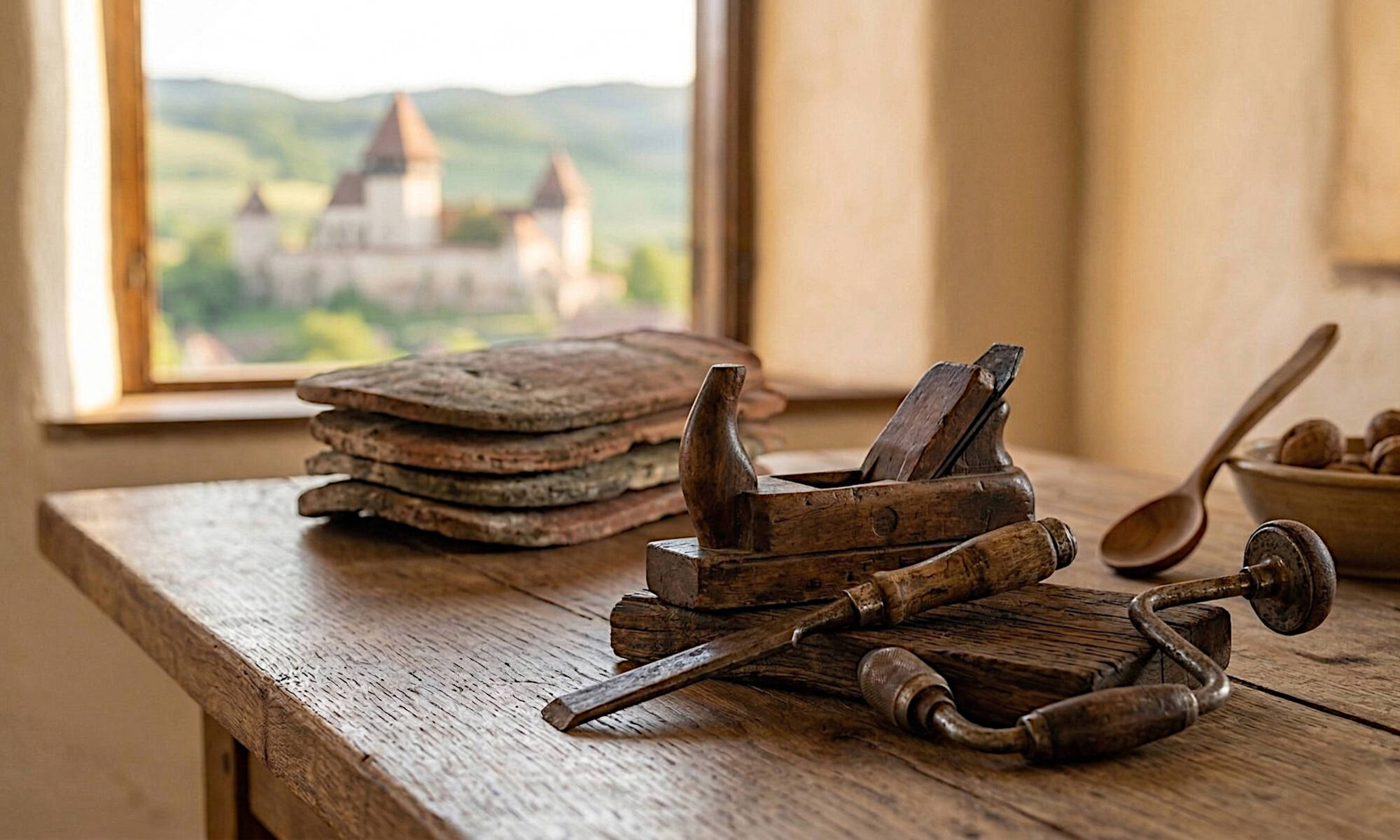

With these posts I want to document finds from my house, in memory of the people who lived there before and as a small glimpse of what life was like back then.
A tool – the adze
On the trail of the past …
While renovating my house I keep finding traces of the past. I have a soft spot for things that belong to the history of an object.
The house once included a joiner’s workshop. It was in a desolate state, which is why, sadly, no inventory and only a few tools have survived.
The last joiner died in the mid-1950s.

One of the pieces I found is this rusty tool. In the picture I have already removed most of the rust.
When Alex visits me and looks at my pile of scrap iron, the thing catches his eye. That is an adze, he says.
Now, during my first apprenticeship I had a lot to do with wood; I learned, for example, to join roof trusses properly with tenons, mortises, lap joints and so on.
So chisels, drawknives, mortising axes and the like are familiar to me, but I never learned back then what an adze is or how to use one.
During one working stay I broke the handle of my pickaxe. It has a special size, nothing you can simply buy. A friend in Romania offered to make me a new one. And what can I say: I was amazed. The new handle is better than the old one; it practically nestles into your hands.

I must try making a handle like that myself some time, I thought, and that reminded me of the adze. From my stock of old timber I took a piece of a fruit-tree trunk home with me.
This weekend I set to work: I split the trunk down the middle and made a handle from it with the circular saw, drawknife and sandpaper.
I removed the rust from the adze, then ground and hardened the cutting edge.
Fitted the handle and tried it out. It works. Even so, it is probably not suitable for daily use. Too much has already corroded away; the socket around the eye is only a few millimetres thick on one side and is torn.
Still far too good to throw away. You can see the blacksmith’s work, every blow of the hammer that gave it its shape. It is one of a kind, not uniform but with a character of its own.
The tree whose wood became the handle was still there when the joiner worked in the workshop, and fed him with its fruit.
It is a wonderful feeling to shape a handle from this wood, fitting it to the hand at one end and to the steel that encloses it at the other.
The adze will find its place in the rebuilt joiner’s workshop, which will accommodate my guests in future. That way a piece of the past stays alive.
