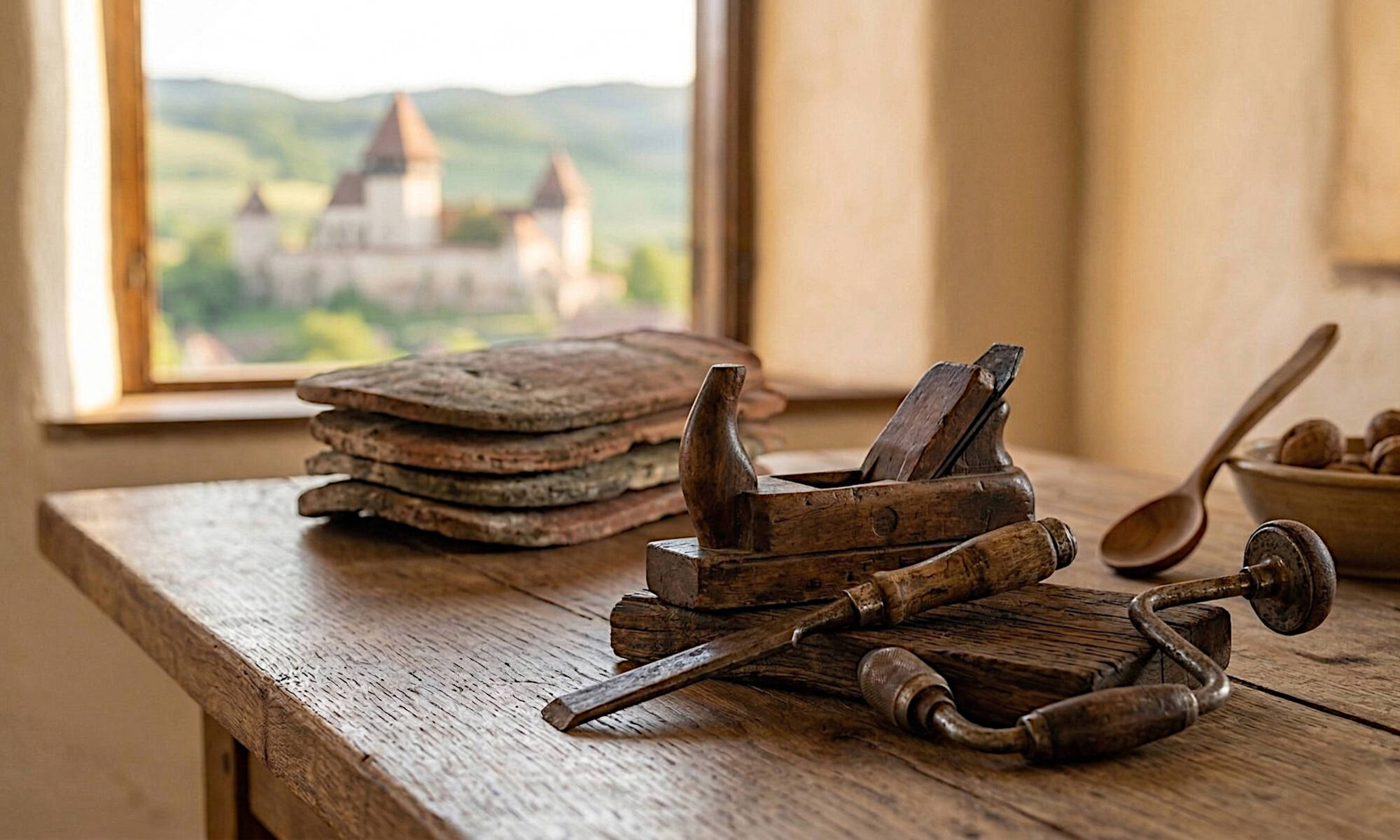

A letter from 1910, found in my house in Cincu: Andreas and Sofie write from Blasendorf to their relatives.
With these posts I want to document finds from my house, in memory of the people who lived there before and as a small glimpse of what life was like back then.
A letter dated 10 February 1910


And here is my attempt to put it into a form that is readable today (translated from the German):
Blasendorf, 10/2/1910
Dear sister and brother-in-law!
We have received your letter, and it does not surprise me that our Misch, after so many years abroad, and so long in a city at that, has quite different ideas from yours. As the saying goes: ‘Another town, another girl’. But as I said, he was in a city for too long. You believe there are girls enough in Groß-Schenk and he can choose whichever he likes, but in Hamburg there are many more, and even if he did not have serious intentions straight away at first: people meet, get to know each other, fall in love, have to part – but nobody stood behind him over this parting.When we were at home in the summer, I said it was time for our Misch to come home, but in your view you were quite right when you said that because of the space – house, yard and workshop – you would first have to build, so let him stay there a few more years, he is better off there. Only someone should have suggested to him that he travel all over Germany and look around, but that costs money, and usually what one gains on one side is lost on the other. Well, dear brother-in-law and sister, that is how the matter looks from the Großschenk side, but it looks different in a city.
In a city one does not marry within the kinship as easily as is hardly avoidable in Großschenk. Here in our small town, where one knows everybody, I believe Sofie and I are the only two from the same nest.Do you not read every week in the agricultural papers that one should not practise inbreeding? I do not think our Misch is wrong at all if he brings a wife from there, only she should not make great demands; then she will find her way in Groß-Schenk too. Of course that does not happen so quickly. Young people in Groß Schenk usually work at their trade in the first years and keep only a little livestock for milk; that soon multiplies, needs more fodder, and so one has to work.
So it goes on until one finally hangs up the trade for the summer and is a farmer without knowing how one actually came to it.
Ann, as for the matter you write about, that you are now ashamed to go among people: just say nothing to anybody, and he should be sensible too and tell you of the joy of becoming grandparents only after 3–10 months, and there is nothing more to it. My wife is sorry that we are missing out on a wedding in the family. We do not know his address; a card has come back to us. We send him our regards, and he should write to us again some time.How is Father doing?
Greetings to you both from
Sofie and Andreas