
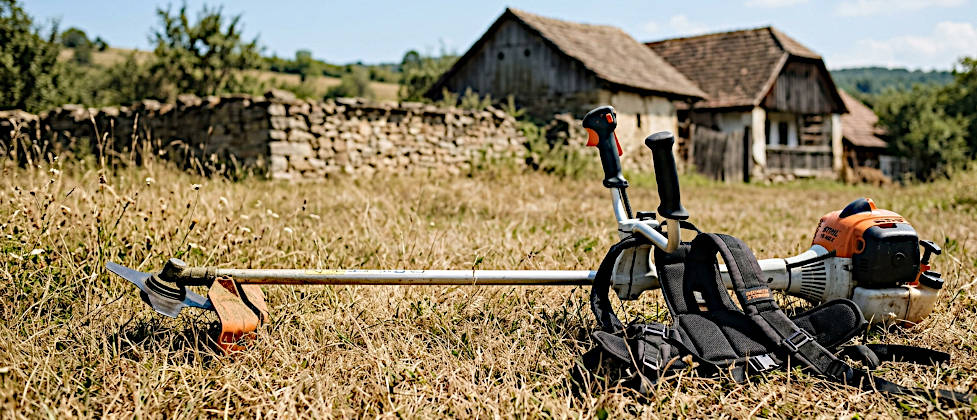
Anyone who owns a large property knows the constant challenge: nature does not wait, it grows. If you are not permanently on site to do your rounds with a classic lawnmower every week, the grass quickly shoots up. It dries out in the summer, forms a dense, resilient mat, and often weeds, small woody shoots, and thick undergrowth mix in. This was exactly the task I faced on our roughly 1000 square meter property in Cincu, our second home in Romania.
A normal petrol lawnmower surrenders immediately under such conditions. A small electric or cordless trimmer from the hardware store has neither the power nor the endurance for such an extensive area. So heavier equipment was needed: a robust brushcutter. The decision quickly fell on a brand-name tool from Stihl. The primary reason for this is simple but essential: the long-term guaranteed supply of spare parts, no matter where you are in Europe.
After careful consideration and weighing up different technical concepts, I finally decided on the Stihl FS 89. In this detailed article, I share my in-depth impressions with you. I will tell you about buying it at the local dealer in Făgăraș, clear up the common misunderstanding surrounding the 4-MIX engine, and explain why an additional investment in the right double shoulder harness takes working comfort to a completely new level.
The Starting Point: Why a brushcutter with a rigid shaft is mandatory?
If you have a property that you only mow from time to time, the mechanical demands on your tool change drastically. The clippings are no longer soft and juicy, but tough, woody, and resistant. Right from the start, it was clear to me: I need a machine that can handle not only a flexible mowing line but also a solid metal blade – more precisely, a grass cutting blade or thicket blade.
To drive such a cutting blade efficiently and, above all, without loss of power and material wear, a rigid drive shaft in the shaft of the brushcutter is an absolute must. Many of the cheaper entry-level models are equipped with a flexible shaft. This works similar to a thick speedometer cable and is perfectly adequate as long as you are only trimming light grass with a mowing head.
However, if a metal blade hits a woody obstacle or very dense undergrowth, a strong mechanical resistance occurs. A flexible shaft twists inside itself, starts to wobble, transfers vibrations to your hands, and can take massive damage over time from hard impacts. A rigid shaft, on the other hand, which is guided by several ball bearings in the shaft, transfers the power of the engine directly and uncompromisingly to the bevel gear. This already narrowed the choice of models down to the semi-professional and professional series.
Stihl FS 89 vs. FS 94 C-E: The direct model comparison
With the requirement of a “rigid shaft, but no oversized, exorbitantly expensive premium forestry model”, two machines were ultimately on the shortlist: The particularly lightweight Stihl FS 94 C-E and the slightly more powerful Stihl FS 89. Before we get to the technology, here is the direct comparison of the two models that I used for my purchasing decision:
| Feature | Stihl FS 94 C-E | Stihl FS 89 |
|---|---|---|
| Drive shaft | Rigid | Rigid |
| Engine type | 2-Stroke (2-MIX) | 4-Stroke-Technology (4-MIX) |
| Fuel | 1:50 Mixture | 1:50 Mixture |
| Weight (dry) | approx. 4.9 kg | approx. 5.8 kg |
| Special feature | ECOSPEED (speed control) | High torque |
| Focus | Ergonomics, fine to normal grass | Power reserves for dense weeds |
The 4-MIX misunderstanding: Why it feels like a 2-stroke
The FS 94 C-E shines with its extremely low weight and the ECOSPEED function, which allows the speed to be throttled. The Stihl FS 89, on the other hand, takes a different technological path. It is equipped with the so-called 4-MIX engine. And here there is a very common misunderstanding that initially made me wonder as well.
Since you fill the tank with a completely normal 2-stroke mixture (1:50), many assume that it is a classic 2-stroke engine. But that is not the case! A 4-MIX engine actually has a camshaft and valves inside like a 4-stroke engine. Stihl’s stroke of genius is that this engine is nevertheless lubricated by the intake fuel-oil mixture. It therefore needs no separate oil pan, no oil filter, and no regular oil changes. You save the weight of the oil circuit, can operate the device in any position (even upside down), and at the same time benefit from the advantages of 4-stroke technology.
The advantages of this design for my intended use were convincing:
- Higher torque: When facing resistance, for example in dense ground cover, the engine pulls through noticeably better and more constantly than a pure, high-revving 2-stroke.
- More pleasant acoustics: The sound profile is significantly deeper and more muffled. The aggressive, high-pitched screech of a classic 2-stroke is missing, making long periods of work more bearable for the ears.
- Emission reduction: Due to cleaner combustion, fewer unpleasant exhaust gases are produced, which is clearly noticeable when working in hollows or depressions.
In the end, besides the engine characteristics, it was primarily the price that tipped the scales. Since I do not need the machine for daily commercial continuous use, the high power reserve of the FS 89 was more important to me than the last gram of weight saving of the noticeably more expensive FS 94 C-E.
The purchase in Romania: Searching for the perfect Motocoasă
Since our property and the restoration project are located in Cincu, Transylvania, it was the only logical consequence for me to buy the garden tool directly on site in Romania. Transporting an almost two-meter-long brushcutter and its cardboard packaging across Europe is extremely impractical. In addition, in the event of warranty claims or for quick spare parts procurement, a local contact is invaluable.
The Romanian term for a brushcutter is Motocoasă (plural: Motocoase). With this term in mind, I drove to the nearby town of Făgăraș. There is an authorized Stihl dealer there: A&V 2008 Solutions. If you want to check out their range in advance, you can find the dealer’s website at www.avtools.ro.
The visit to the store was totally worth it. The advice was extremely friendly, expert, and targeted. You notice immediately when you are in a real specialist workshop that not only pushes boxes around but also maintains and repairs the equipment itself.
The price level for Stihl equipment is generally slightly lower in Romania than in Germany, which is due to the manufacturer’s regionally adapted pricing policy. But in the shop in Făgăraș, I was even able to negotiate a special offer price. Ultimately, around 400 euros changed hands. An absolutely outstanding deal for a fully equipped brand-name tool in this performance class.
The scope of delivery already included the standard mowing head (Cap tăietor cu fir) and a two-tooth metal blade (Disc de tăiere pentru iarbă). Safety glasses and the simple standard carrying strap were also included. I was perfectly equipped to get started.
The Stihl FS 89 in a detailed practical test
Together with Elisabeth, I have extensively tested the new Motocoasă on our 1000 square meters over the past few weeks. The property in Cincu is typical for the Carpathian region: in spring, the green literally explodes, whereas in summer the sun beats down mercilessly. The ground becomes hard, dry, and the grass grows dense and tough. This is the absolute ideal terrain to put the various supplied cutting tools through their paces.
Preparation: Mixture and starting behavior
Before you can start, the tank must be filled. As already mentioned: the 4-MIX engine also uses a 1:50 two-stroke mixture. I strongly advise you, especially with irregular use, to rely on ready-mixed special fuel like Stihl MotoMix (or comparable alkylate petrols from other manufacturers). Conventional petrol from the gas station separates over the months. The ethanol binds water, which can lead to corrosion in the carburetor. Alkylate petrol is chemically pure, almost odorless, does not attack plastic parts, and can be stored for years. The engine will thank you with an immediate start, even if the device has been sitting idle in the shed all winter.
The starting process itself is very simple thanks to the manual fuel pump (primer). Press a few times, set the choke, one or two pulls on the rope, and the engine comes to life with a pleasantly sonorous, powerful chugging.
Trimming work with the mowing line
The mowing head (AutoCut) is the ideal tool for fine work. We use it mainly to cleanly cut the edges along fences, along the old stone walls of our house, or around the tree trunks in the garden. The line adapts to the contours of hard obstacles without immediately damaging them.
The FS 89 delivers more than enough pulling power here. As soon as the line gets shorter, you simply tap the mowing head lightly on the ground while the engine is running, and centrifugal force automatically pulls out new line. The small blade on the plastic skirt then precisely cuts it to the correct length.
However, the major disadvantage of the mowing line quickly becomes apparent on the large, open area with our extremely dry ground: it doesn’t cut the grass, it smashes it. This high rotational energy combined with the dusty soil causes an enormous amount of dirt, fine sand, and small stones to be kicked up. In addition, the line breaks off quickly on hard, woody weeds, which means high wear and tear and distributes microscopically small plastic particles on the property.
Switching to the two-tooth blade
The true strength and actual purpose of the machine become apparent as soon as you remove the mowing head and mount the grass cutting blade. A two-tooth blade is perfectly adequate for dry grass and offers a very high area performance.
The difference when mowing is enormous. With the metal blade, the brushcutter works like a traditional scythe, only machine-driven. The dry grass is cut with a clean stroke. Almost no dust is kicked up anymore. The work progress on the large open area multiplies. You can swing the machine in large, steady pendulum movements. The nearly 1.3 HP (0.95 kW) of the engine pulls through confidently. Even when Elisabeth or I advance into denser weed patches or when small saplings are in the way, the speed does not drop.
Safety first: Personal protective equipment
A brushcutter of this performance class is not a toy. The rotating tool accelerates stones, pieces of wood, or hard clods of earth to the speed of projectiles. Therefore, I would like to specifically address personal protective equipment (PPE) at this point.
Simple sunglasses are not enough here. I always wear the following when working:
- Sturdy footwear: Ideally safety shoes with steel toes, but at least very firm leather boots that reach above the ankles. Rubber boots or even sneakers have absolutely no place when working with a metal blade.
- Face protection: A visor with a wire or plastic mesh protects the entire face from flying objects. Underneath, I also wear safety glasses to protect my eyes from fine dust.
- Hearing protection: Even though the 4-MIX engine sounds more pleasant, it still produces a volume that can damage your hearing during extended work. Earmuffs are mandatory.
- Long, sturdy clothing: Even in the hottest Romanian summer, I exclusively work in long, thick trousers. Anyone who has ever been hit on the bare shin by a thrown stone knows exactly why.
You can also find further information on safe workwear directly in the Stihl safety guides.
The absolute game-changer upgrade: The Stihl double shoulder harness
Despite the initial enthusiasm for the engine power of the FS 89, there was one aspect during our first deployments that heavily clouded the pleasure: wearing comfort.
The Stihl FS 89 has a dry weight of 5.8 kilograms. If you fill the tank and mount a solid metal blade along with the protective guard, you quickly reach a working weight of over six and a half kilograms.
The narrow single shoulder strap supplied as standard with the device is perfectly usable for a short job to clean up a few edges. But when you start to systematically work through 1000 square meters row by row, the weight pulls relentlessly on one side of your shoulder and neck after about half an hour. It became extremely uncomfortable, led to tension, and massively disrupted the workflow. Elisabeth also found the one-sided weight to be very stressful.
Therefore, I quickly made the decision to improve this and spent another 50 euros. I ordered the original Stihl ADVANCE double shoulder harness (Item number: ST_41197109001). Without exaggeration: this investment completely revolutionized the feeling of working.
The structure of this harness is reminiscent of the carrying system of a high-quality trekking backpack. It consists of two wide, softly padded shoulder straps and a stable back plate. The crucial element, however, is the side support plate with the hook for the machine.
How to adjust the harness correctly
In order for the harness to develop its full effect, it must be adjusted to your body and the machine:
- Put the harness on and close the fastener across your chest. The straps should fit snugly but not dig in. The weight must be distributed evenly across both shoulders.
- The side support plate, where the brushcutter will later hang, should be exactly at the height of your right hip. It serves as a pivot point.
- Hang the brushcutter in the hook. Now comes the most important step: the balance. Loosen the clamping screw of the suspension ring on the shaft of the brushcutter and slide the ring back and forth until the cutting tool (blade) hovers just above the ground when hanging freely.
When the machine is perfectly balanced, you no longer carry the weight with your arms. The double shoulder harness transfers the load from your arms over your shoulders directly into your torso. A soft pad on the support plate protects the hip bone from vibrations. Instead of laboriously lifting and carrying the machine, you now simply guide it with the wide two-hand handle in a clean pendulum movement out of your upper body to the right and left. The work becomes effortless, ergonomic, and far less tiring. If you plan to work on larger areas, buy this harness right from the start. It is the best accessory you can treat yourself to.
Care and maintenance for longevity
Since we do not use the brushcutter every week, but often leave it in the dry shed in Cincu for months, proper maintenance is crucial so that the joy of the tool is preserved for a long time.
- Check gearbox grease: At the bottom of the bevel gear, exactly where the cutting tool rotates, there is a small screw plug. The gear housing here must be regularly supplied with a special, heat-resistant Stihl gearbox grease. Since we only use the machine occasionally, I unscrew the plug once a year. If I can see the grease, everything is fine. If not, I squeeze some lubricant from the tube.
- Valve clearance (Specific to 4-MIX): Since the engine has valves, the valve clearance must be checked and, if necessary, adjusted after the first 130 operating hours according to the manual. For normal private users, it takes years to reach this number of hours. I then gladly leave this work to the specialist workshop in Făgăraș.
- Cleaning after using the blade: When cutting high, slightly damp grass, plant fibers often wrap around the gearbox and under the protective cover. The resulting plant sap is aggressive. After mowing, I always remove the coarse dirt with a stiff brush so that no moisture remains on the metal housing.
- Winter storage: Before the long winter break, I empty the fuel tank completely. Then I start the engine and let it run at idle until it stops on its own. This ensures that the carburetor is completely empty and no fuel residue can stick to the fine membranes over the winter.
Final thoughts on property maintenance
Looking back, the combination of buying locally in Romania and opting for the powerful FS 89 was absolutely the right decision. The intensive consultation at A&V 2008 Solutions gave me confidence. With its enormous torque, the machine delivers exactly the performance required on the rough terrain in Transylvania.
The dense, dried-out summer grass is absolutely no obstacle anymore with the two-tooth metal blade. Since I retrofitted the professional ADVANCE double shoulder harness, even mowing the entire 1000 square meter area is no longer a grueling torture for the shoulders and back, but is done quickly, structurally, and almost meditatively.
If you are facing a similar challenge and own a property that is a bit more rustic, I can highly recommend this technical configuration of a rigid drive shaft, high-torque 4-MIX engine, and a high-quality harness system.
Have you had your own experiences with property maintenance or do you have any specific questions about operating the FS 89? Feel free to leave me a comment below this post.