Lost places in Transylvania: how to photograph abandoned factories and mines, with exposure bracketing and a safety checklist.
Anyone who thinks of Transylvania usually pictures picturesque wooden churches, gentle hills and bears in the deep forests of the Carpathians. But beyond this idyll lies a completely different, rough side of Romania: the silent witnesses of the massive industrialisation of the communist era. Huge abandoned factories, disused mines and decaying houses of culture offer an incomparable aesthetic of decay.
Photographing these “lost places”, known as urban exploring (urbex), holds an enormous fascination. Nature is reclaiming the concrete piece by piece. But striking pictures in these abandoned halls require not only technical know-how but also meticulous preparation.
The photographic challenge: mastering light and shadow
The lighting conditions in old industrial ruins are usually extreme. Harsh sunlight falls through broken roofs and smashed windows into factory halls that are often pitch dark. The dynamic range of these scenes is too much for the sensor of any modern camera. The solution to this problem is bracketing (exposure series).
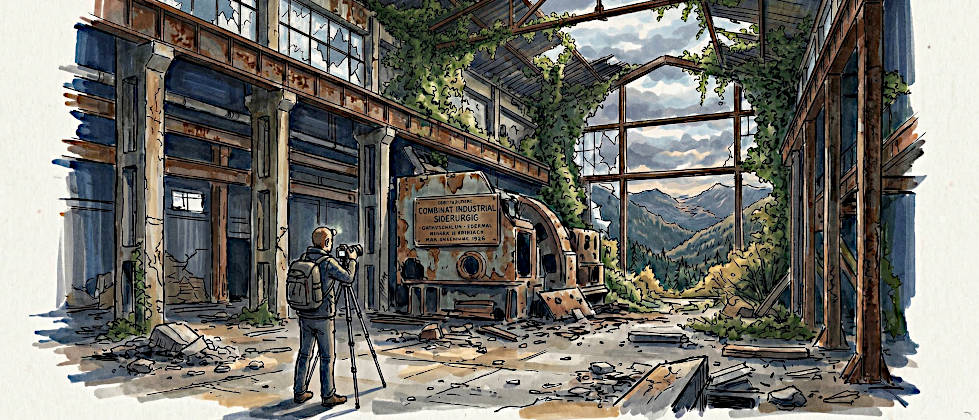
Instead of relying on a single picture, you take a series of three to five pictures with different exposure times. Later these shots are merged into an HDR (high dynamic range) image in post-processing. That way the windows do not blow out to pure white and the dark corners of the hall do not drown in black. A sturdy tripod and an extremely wide-angle lens are essential for these architectural shots in order to capture the sheer size of the sites.
Equipment and safety in the ruins
Lost places are not museums. Open shafts, rotten wooden floors, hanging steel girders and invisible trip hazards in the rubble pose real dangers. Anyone who goes in here without the right equipment risks serious injury.
Safety packing list for urban exploring
- Sturdy footwear: Essential, with a puncture-resistant sole because of rusty nails and broken glass.
- Light sources: A powerful head torch (keeps your hands free for the camera) and a backup torch.
- Tripod: Indispensable for long exposure times in dark halls.
- First-aid kit: Disinfectant and plasters for small scratches and cuts.
The urbex code and the legal situation on site
For urban explorers the iron rule applies worldwide: “Take nothing but pictures, leave nothing but footprints.” Nothing is destroyed, nothing is taken away and nothing is broken open. If a building is locked, it stays locked.
In Romania, especially in the old industrial regions around Hunedoara or in the Jiu Valley, there is another pragmatic approach as well. Often these huge, seemingly abandoned sites are not completely unguarded. You frequently meet watchmen in small huts at the factory gate, or local residents. It is almost always worth asking politely (with hands and feet if necessary) for permission to take photographs. A respectful manner opens an astonishing number of doors here, provides legal certainty and sometimes even brings fascinating background stories from the locals.
Have you ever been out exploring abandoned places?
What experiences have you had with urban exploring, whether in Romania or elsewhere? Do you perhaps have a special tip on how best to capture the sombre mood of these industrial ruins? Feel free to share your thoughts and experiences in the comments!