Last updated: November 2026
For me, the fortified churches in the Harbach Valley are among the quietest and most photogenic subjects in all of Transylvania in late autumn. When the November sun travels low across the ridges, it casts a raking light over gate towers, ring walls and hand-laid beaver-tail roofs that reveals every irregularity in the masonry. In this post I take you along on my photographic tour of the fortified churches of Hosman, Nocrich and Marpod – with route, history, light times and my practical tips for detail shots.
At a glance: Fortified churches in the Harbach Valley
- Region: Harbach Valley (Valea Hârtibaciului), Sibiu County, Transylvania, Romania
- Villages: Hosman (Holzmengen), Nocrich (Leschkirch), Marpod
- Distance: A little over 30 km from Sibiu (Hermannstadt) each
- Duration: One full day by car
- Best light in November: Low light all day, sunset roughly between 4:40 and 5:00 pm
- Visiting: Interiors usually only with a key holder, contacts via the Fortified Churches Foundation
Contents of this post
- Why I photograph the Harbach Valley in November
- The route to the fortified churches in the Harbach Valley
- Fortified church of Hosman (Holzmengen)
- Fortified church of Nocrich (Leschkirch)
- Fortified church of Marpod
- Photographing in the low November sun
- Practical travel information
- Frequently asked questions
- Contacts and further information
Why I photograph the Harbach Valley in November
Most travellers come to Transylvania in summer. I understand that, but for me the most beautiful season begins once the tour groups have long gone home. The Harbach Valley – Valea Hârtibaciului in Romanian – lies northeast of Sibiu and stretches as a wide, gently rolling valley towards Agnita. In November the hills are steeped in ochre, rust brown and faded green, mist hangs in the hollows in the morning, and over everything lies a calm I rarely find anywhere else.
For photography, this is a gift. At this time of year the sun stands only about 25 to 28 degrees above the horizon even at noon, and lower still at the end of November. That means you have soft, sideways light practically all day, and the warm evening light already begins in the early afternoon. This raking light is exactly what I need to bring out the structure of old fieldstone walls, the edges of arrow slits and the slightly irregular rows of handmade tiles.
The route: Three fortified churches in the Harbach Valley in one day
Hosman, Nocrich and Marpod each lie a little over 30 kilometres from Sibiu and can be combined in one day, as long as you take your time for the light and don’t just want to tick them off. You reach Nocrich via the country road towards Agnita after about 32 kilometres. Hosman belongs administratively to the commune of Nocrich and lies to the south of it, with a view of the Făgăraș Mountains. Marpod, about 34 kilometres from Sibiu, is a commune of its own in the east of Sibiu County and lies on the stream of the same name. I always plan the exact route shortly beforehand with a map app, because some side roads can be difficult to drive after rain.
I plan my order according to the light, not the shortest route:
- Morning – Hosman (Holzmengen): Morning mist over the village and, on clear days, the Carpathian peaks in the background.
- Midday – Nocrich (Leschkirch): The neoclassical church with its smooth surfaces copes best with the somewhat harsher midday light.
- Afternoon to sunset – Marpod: The hidden complex with its ring wall is my favourite for the last, low raking light.
In November the sun sets in this area roughly between 4:40 and 5:00 pm local time, depending on the date. So make sure you are at your evening subject in good time. A car is practically indispensable, as public transport to the villages of the Harbach Valley is scarce.
Fortified church of Hosman (Holzmengen): Romanesque portal and gate tower in the morning light
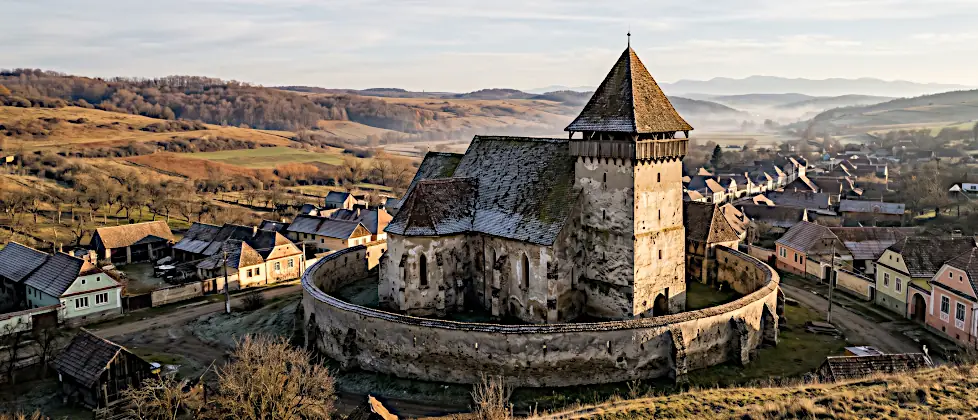
When I arrive in Hosman in the morning, I can already see the fortified church from the road. It towers above the village, and on clear autumn days the peaks of the Făgăraș Mountains, more than 2,500 metres high, appear behind it. No wonder it is one of the most photographed fortified churches in Transylvania. The village, called Holzmengen in German, was first mentioned in a document in 1319 as “Holzmenia”; in 2019 it celebrated its 700th anniversary. Today just under 800 people live here.
History in stone: What the complex tells us
It all began with a Romanesque basilica from the 13th century. Its west portal has survived and is considered one of the most valuable examples of Romanesque architectural sculpture in Transylvania. Above it, a relief with two figures is set into the wall, and its meaning is still debated: some see the Baptism of Jesus, others Adam and Eve. Around 1500 the side aisles were demolished, and the bell tower was raised and given a wooden wall walk on corbels. In the 15th century two defensive walls were built, connected by a gate tower. Remains of the wall walk and arrow slits are still visible.
What makes Hosman special for photography
For me, there are three subjects in Hosman that come into their own in late autumn. The first is the massive gate tower. In the low morning light falling obliquely on the façade, repairs, layers of plaster and individual stones become visible. I stand slightly to the side so the light grazes across the wall rather than hitting it head-on. The arrow slits then look three-dimensional, and the shadows under the eaves give the tower depth.
The second is the wooden wall walk of the bell tower. The corbels it rests on cast long, regular shadows in the low sun – a subject for which I need a telephoto lens. The third is the Romanesque west portal with its enigmatic relief. Here the soft light helps bring out the delicate, weathered forms without harsh shadows swallowing them.
The view from above onto the village roofs is also worthwhile. The rows of beaver-tail tiles, marked by moss and lichen, form almost graphic patterns through a telephoto lens. If there is still hoarfrost on the tiles, you only have a short window before the sun melts it away. That is one of the reasons why I put Hosman in the morning.
The people who keep Hosman alive
What impresses me about Hosman is the local commitment. The CEPIT association looks after the parish house, has set up a youth meeting centre there and organises restoration workshops and cultural events. The Hosman Durabil association supports the development of the village. The hometown association (HOG) of Holzmengen, made up of emigrated Transylvanian Saxons, also lends a hand again and again with work sessions at the fortified church. Since 2018 a Christmas market has been held on the grounds of the fortified church – dates vary, so check with the organisers beforehand.
Hosman is also one of the starting points of the Brukenthal cultural trails, on which you can explore the surroundings on tours of up to nine days. For photographers, this is a lovely way to discover the Harbach Valley away from the road.
Fortified church of Nocrich (Leschkirch): Birthplace of Baron Brukenthal
Nocrich, Leschkirch in German and Újegyház in Hungarian, won’t overwhelm you with size. At first glance the fortified church looks unassuming. Its history, however, carries weight: Samuel von Brukenthal was born here on 9 April 1721, the only Transylvanian Saxon ever to become Governor of the Grand Principality of Transylvania. He held office from 1777 to 1787 and died in Sibiu in 1803. His art collection still forms the core of the Brukenthal National Museum on the Large Square (Piața Mare) in Sibiu.
A church younger than its walls
What fascinates me about Nocrich: the present church is younger than its fortifications. The Romanesque basilica from the 13th century was demolished at the beginning of the 19th century. Between 1803 and 1806 a new church in neoclassical style was built to the south of it, unusually oriented north–south. Construction cost 8,950 florins, of which Baron Brukenthal donated 1,000. His family pew has survived in the choir, as has an organ built by Samuel Mätz in 1806.
Nocrich was also an important place for a long time: in 1589 it was granted the status of a market town (oppidum) and the right to hold two annual fairs. The Transylvanian prince Michael Apafi visited the village twice; an inscription on a rectangular tower commemorates this.
Nocrich / Leschkirch at a glance:
- Location: about 32 km northeast of Sibiu, on the road towards Agnita
- Known as: birthplace of Samuel von Brukenthal (1721–1803)
- Present church: 1803–1806, neoclassical, north–south orientation
- Special feature: inscription on a tower recalling the visits of Prince Michael Apafi
- Visiting: contact via the Evangelical parish of Agnita (Agnetheln), current details from the Fortified Churches Foundation
Photographing Nocrich at midday
I deliberately schedule Nocrich for the middle of the day. The smooth surfaces of the neoclassical building cope with the somewhat harsher light better than the rough fieldstone walls of Marpod. At midday I concentrate on details: the inscription on the tower, door fittings, window reveals and the transitions between old masonry and newer plaster. A polarising filter helps me reduce reflections on windows and makes the autumn sky appear a deeper blue.
If you also look inside the church, take a look at the pulpit from 1825 with its gilded reliefs, including the Brukenthal coat of arms. Interior shots are usually only possible by arrangement, and I always ask on site whether photography is allowed.
Fortified church of Marpod: Hidden behind trees, ideal in the last light
For me, Marpod is the most mysterious of the three fortified churches in the Harbach Valley. The complex sits discreetly behind trees and undergrowth, and you almost have to search for it. The village was first mentioned in 1349 as “Meyerpoth” and around 1500 was a free community of the Leschkirch Seat – at that time only 13 families, a schoolmaster and two shepherds lived here.
History in layers
Like most churches in the Harbach Valley, St Mary’s Church in Marpod goes back to a three-aisled Romanesque basilica from the 13th century. A Romanesque capital from this first building is now walled into a southern pillar. The fortified church was built around 1500; in the late 15th and early 16th centuries, Marpod even received money from the treasury of the Sibiu province for work on the towers. In 1669 the community was allowed to collect alms to rebuild the church and tower, which had been set on fire by the Tatars. The church acquired its present appearance between 1785 and 1798.
The church is surrounded by a quadrangular ring wall, at whose corners four towers originally stood. Only parts of them survive today, and accounts of the condition of the individual towers differ. It is precisely this incompleteness, the gaps and cracks, that makes Marpod feel so honest to me. Inside stands an organ with a Baroque case, built by Johannes Hahn in 1762, and a three-part altar with a central painting by the Sibiu painter Hans Hermann from 1926.
Raking light on fieldstone: How I photograph Marpod
In the late afternoon the light falls low through the bare trees in Marpod. This is the moment I work towards all day. The ring wall takes on a warm colour, and every stone casts its own small shadow. Here I like to work with a short telephoto lens between 85 and 135 millimetres and look for details: a tower corner with eaves, the pattern of the beaver-tail tiles, an arrow slit covered in lichen.
The bare branches in front of the wall, which would be distracting in summer, become a natural frame in November. Their shadows draw fine lines across the masonry. Shortly before sunset I switch to a wide-angle lens to capture the whole complex in the last glow of the sky.
Photographing in the low November sun
I am often asked what I do differently in late autumn than in summer. The honest answer: I work more slowly and follow the light. Here are the points that have helped me most with the fortified churches in the Harbach Valley.
Using raking light deliberately
Raking light means that light falls across a surface at a very shallow angle. As a result, even the smallest bumps cast shadows and the texture becomes visible. That is ideal for walls, plaster and tiles. I therefore usually position myself so that the sun comes from the side, roughly at a right angle to the shooting direction. Frontal light makes walls look flat, backlight turns them into silhouettes. Both can be appealing, but for detail shots side light is my first choice. With an app that shows the position of the sun, you can see in advance when each side of a wall will be in raking light.
Gear that has proven itself for me
- Telephoto lens (70–200 mm): For tower details, wall walks, roof patterns and compressing layers of landscape.
- Standard zoom (24–70 mm): For overall views and courtyards.
- Polarising filter: Reduces reflections and intensifies the autumn sky.
- Lightweight tripod: For dusk and for interiors, where permitted.
- Spare batteries: Cold drains them faster, so I carry them in my inside jacket pocket.
Exposure and contrast
Low sun creates strong contrasts between bright wall surfaces and deep shadows. I prefer to underexpose slightly to protect the highlights and recover the shadows later in editing. When contrast is very high, I shoot an exposure bracket. I set the white balance manually to daylight so the warmth of the evening light isn’t automatically “corrected”. I also shoot in RAW, because it gives me much more latitude with the subtle brown tones of tiles and fieldstone.
Drone? Better check beforehand
The ring walls in particular look spectacular from above. However, drone flights in Romania are subject to their own rules, and special consideration is required over villages and church grounds. Before every trip I check the current requirements of the Romanian civil aviation authority and also ask on site whether a flight is acceptable.
My tip for detail shots: Don’t photograph a beaver-tail roof from below; look for a raised position instead – a slope, a wall walk or the village street above. If you shoot as parallel to the roof surface as possible, the rows of tiles stay evenly sharp, and the slight irregularities of handmade tiles show up much better.
Travel information for the Harbach Valley
Getting there and where to start
The best starting point is Sibiu with its international airport. From there it takes about 45 minutes to drive into the Harbach Valley. The roads are mostly paved but partly bumpy in the villages. In November you should expect fog, wet leaves and occasionally the first frost. Drive carefully and watch out for horse-drawn carts and animals on the road.
Visiting and keys
The fortified churches in the Harbach Valley are not museums with fixed opening hours. Usually someone in the village has the key, often a curator (church warden) of the parish. You can find the current contacts on the website of the Fortified Churches Foundation. Whenever possible I get in touch a day in advance and leave a donation when I visit – for the small communities this is important support.
Accommodation and food
There are only a few places to stay in the villages, so I recommend booking a night in Sibiu or in a guesthouse in the area. For groups there is a special option: the youth centre in the parish house of Hosman offers 25 beds in three rooms, plus a kitchen and a large garden. On the way, it’s worth asking in village shops and on small farms for regional products such as cheese, honey or bread.
Clothing and timing
In November it can be frosty in the morning but pleasantly mild at midday. Layers, waterproof shoes and gloves that let you operate your camera have proven their worth for me. The days are short: if you want to photograph three fortified churches in good light, start early.
Checklist for the tour to the fortified churches in the Harbach Valley:
- Rental car from Sibiu
- Check key-holder contacts in advance with the Fortified Churches Foundation
- Cash in lei for donations and village shops
- Spare batteries, polarising filter, telephoto lens
- Warm, waterproof clothing
- Plan for sunset roughly between 4:40 and 5:00 pm
Frequently asked questions about the fortified churches in the Harbach Valley
Where is the Harbach Valley?
The Harbach Valley (Romanian: Valea Hârtibaciului) is located in Transylvania in Sibiu County, northeast of Sibiu. It stretches along the Harbach River (Hârtibaciu) towards Agnita and is known for its many fortified churches built by the Transylvanian Saxons.
Can you visit Hosman, Nocrich and Marpod in one day?
Yes. All three villages are a little over 30 kilometres from Sibiu and can be combined by car in one day. For the best light, I recommend Hosman in the morning, Nocrich at midday and Marpod in the late afternoon.
Are the fortified churches in the Harbach Valley freely accessible?
You can usually see the complexes from the outside. For the interiors you generally need a key holder from the village. The Fortified Churches Foundation provides the contacts on its website. A donation towards their upkeep is customary and welcome.
Are the fortified churches in the Harbach Valley UNESCO World Heritage Sites?
No. Hosman, Nocrich and Marpod are not on the World Heritage List. Transylvanian fortified churches with UNESCO status include, for example, Biertan (Birthälm) and Viscri (Deutsch-Weißkirch).
Why is November a good time for photography in Transylvania?
In November the sun stays low all day. The sideways raking light emphasises the structures of walls, gate towers and beaver-tail roofs. Add to that autumn colours, morning mist and hardly any visitors.
Who was Samuel von Brukenthal?
Samuel von Brukenthal (1721–1803) was born in Nocrich and was Governor of the Grand Principality of Transylvania from 1777 to 1787. His collection forms the core of the Brukenthal National Museum in Sibiu.
Contacts and further information
- Fortified Churches Foundation – information, key-holder contacts and ways to donate
- Fortified church of Hosman / Holzmengen – history, youth centre and contacts
- Fortified church of Nocrich / Leschkirch – history and contacts
- Fortified church of Marpod – history and contacts
- Agramonia: Chronicle of Nocrich
- Agramonia: Chronicle of Marpod
- Brukenthal National Museum in Sibiu
What fascinates me about the Harbach Valley
Every time I drive through the Harbach Valley in late autumn, I notice how much this landscape lives from the light. The fortified churches of Hosman, Nocrich and Marpod are not polished tourist sights. They are witnesses of centuries, marked by raids, reconstruction, emigration and the dedication of the people who preserve them today. In the low November light their gate towers, wall walks and roofs tell these stories more clearly than in any other season.
If you embrace the slow pace, you will be rewarded with images that show more than architecture: atmosphere, time and a piece of the Transylvanian soul. I hope my photographic tour guide helps you plan your own round of the fortified churches in the Harbach Valley. Feel free to tell me in the comments which fortified church interests you most – or whether you have already been there yourself.