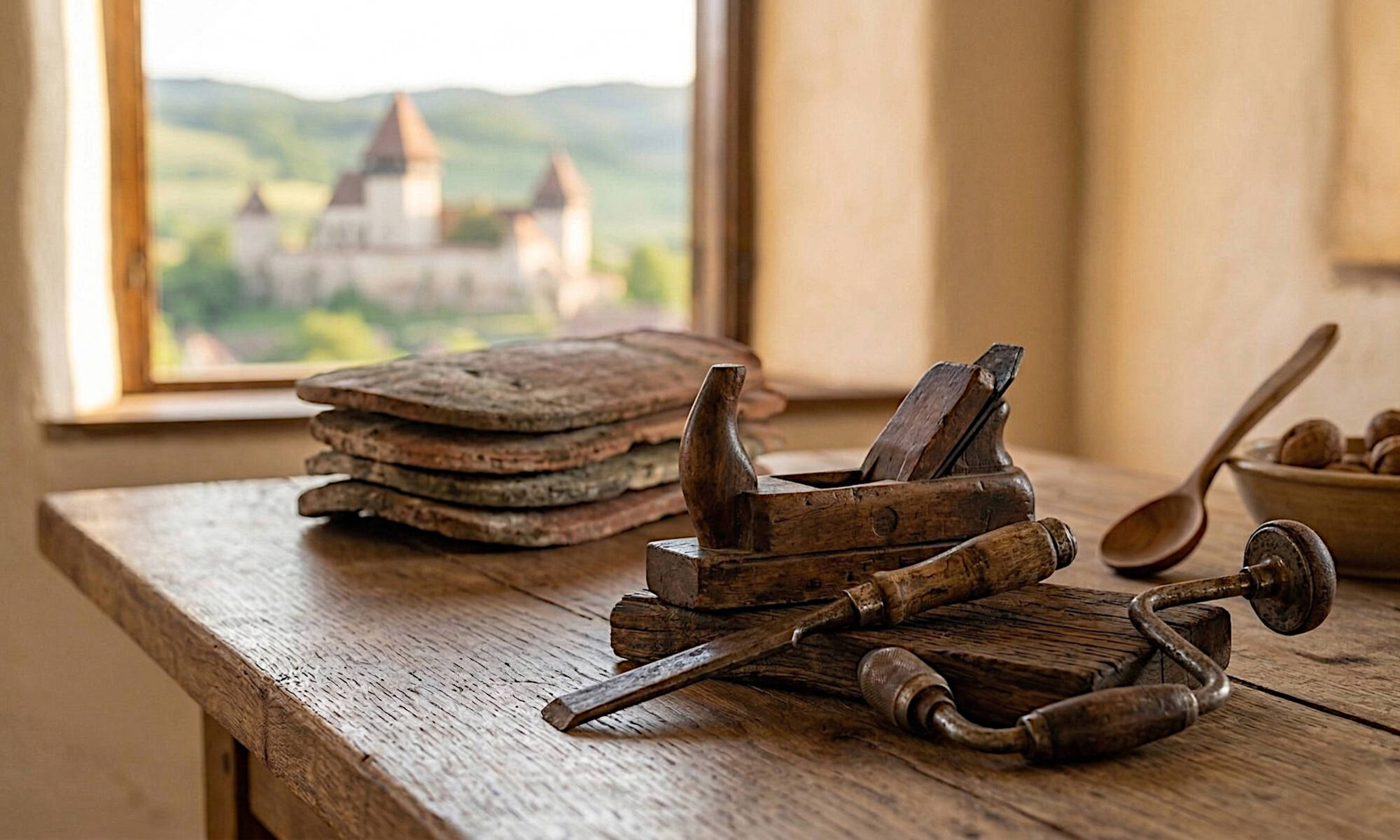
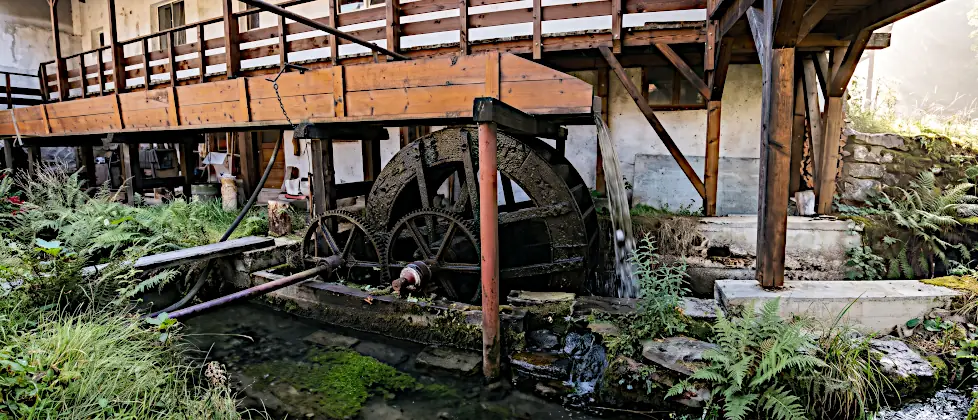
The Făgăraș Land (Țara Făgărașului) is one of the quietest and most rewarding landscapes in Romania for photographers. Between the Olt River to the north and the Făgăraș Mountains to the south lie villages whose mountain streams are still lined with old water mills, fulling mills and wooden water wheels, some of them still in operation. In this guide I take you along on my photo trip through the Făgăraș Land: to the mills, to the historic farmsteads and into the low morning light that makes this region so special.
Key facts at a glance
- Region: Țara Făgărașului (English: Făgăraș Land or Făgăraș Country) in Transylvania, mostly in Brașov County, with its western part in Sibiu County
- Location: between Sibiu (Hermannstadt) and Brașov (Kronstadt), along national road DN1
- Subjects: water mills (mori de apă), fulling mills (pive), whirlpool basins (vâltori) and traditional farmsteads
- Best time to travel: May and June (plenty of water) and September and October (mist, autumn colours, soft light)
- Best light: the first hour after sunrise
- Recommended length of stay: 4 to 6 days, one valley per morning
Contents:
- What is the Făgăraș Land?
- Why there are so many water mills here
- My photo tour in five stages
- Photographing in the morning light
- Historic farmsteads
- Practical tips for your trip
- Useful contacts and further information
- Frequently asked questions
What is the Făgăraș Land? A brief introduction
The first time I drove from Sibiu to Brașov, the Făgăraș Mountains were on my right the whole way: a mountain chain around 70 kilometres long, with Moldoveanu (2,544 m) and Negoiu (2,535 m), the two highest peaks in Romania. Back then I barely noticed the land at the foot of these mountains. It is a gently sloping plain, crossed by dozens of streams that flow north from the ridge into the Olt.
This land is Țara Făgărașului. Historically, the Făgăraș Land was a distinct territory with a predominantly Romanian population and a Romanian lower nobility, the boyars. At times it was even held as a fief by the princes of Wallachia. Unlike many places north of the Olt, the villages here were not founded by Transylvanian Saxons. They grew over centuries as Romanian farming and shepherding villages, and you can still see that today in the gateways, in the layout of the farmsteads and in the way water was put to use.
For me as a photographer, the Făgăraș Land is an open-air museum that nobody has declared a museum yet. Every stream coming down from the mountains once had its mills. Many have fallen into ruin, some have been converted, and a few are actually still running.
Why there are so many water mills in the Făgăraș Land
The answer lies in the geography. The streams of the Făgăraș range rise at over 2,000 metres and reach the floodplain of the Olt, at around 400 metres, after just 20 to 30 kilometres. That steep drop means power, and snowmelt and mountain rain keep the streams flowing almost all year round.
People in the Făgăraș Land used this power mainly for three kinds of installations:
- Grain mills (mori): for grinding maize and wheat, often with a horizontal water wheel directly beneath the mill house.
- Fulling mills (pive, singular piuă): a water wheel turns a shaft with cams. The cams lift heavy wooden hammers and let them drop onto damp, woven woollen cloth. This produces the dense, water-repellent cloth that farmers’ and shepherds’ coats and trousers were once made from.
- Whirlpool basins (vâltori, singular vâltoare): funnel-shaped wooden basins into which water shoots from above through a chute. The resulting whirlpool washes and felts woollen blankets (cergi) and rugs until they are soft and fluffy.
Because sheep farming and shepherding played a major role in the Făgăraș Land, wool was a key raw material here. That is why you will find not only grain mills along the streams, but a small water-powered industry built of wood that works entirely without electricity or chemicals.
My photo tour along the mountain streams at the foot of the Făgăraș range
I planned my tour from west to east. That way I could move on a little each day and spend the night close to the next subject. Allow at least one full morning per valley. The mills won’t run away, but the good light is gone after about 90 minutes.
| Stage | Places | Focus |
|---|---|---|
| 1 | Cârțișoara | Gateways, old mill races, Badea Cârțan Museum |
| 2 | Arpașu de Sus, Victoria | Stream landscape with morning mist, practical base |
| 3 | Viștea, Drăguș | Wooden details, folk costume and customs |
| 4 | Sâmbăta de Sus | Brâncoveanu Monastery, farmsteads along the Sâmbăta stream |
| 5 | Breaza, Lisa, Pojorta | Working fulling mill and vâltoare |
Stage 1: Cârțișoara at the gateway to the Transfăgărășan
Cârțișoara lies where the famous Transfăgărășan high road turns off into the mountains. Most visitors drive straight through, up to Bâlea Lake. I took the time to walk through the side streets. Many of the typical farmsteads are still here, with tall, roofed wooden gates behind which the house, stable and barn are grouped around an inner courtyard.
Along the stream I discovered the remains of old mill races, partly overgrown: stone weirs, rusty sluice gates, rotting wooden channels. If you are after details rather than postcard views, you will find them here. The village also has a small museum dedicated to Badea Cârțan, a peasant who walked all the way to Rome in 1896 to see Trajan’s Column.
Stage 2: Arpașu de Sus and Victoria
Further east, the Arpaș stream comes down from the mountains. Around Arpașu de Sus I experienced one of the most beautiful mornings of the whole trip. I was already standing by the stream at dawn, with mist hanging over the water. When the sun rose over the plain, the mist glowed golden for a few minutes, and the wet stones and old wood on the bank suddenly gained texture and colour.
Victoria is a very different place: a small town that grew up around a chemical plant from the late 1940s onwards. It holds little interest for mill photography, but it is a practical base with accommodation, supermarkets and a petrol station.
Stage 3: Viștea and Drăguș
In Viștea de Jos and Viștea de Sus, the Viștea stream flows through the villages. Here I concentrated entirely on details: wooden pegs in old beams, worn door handles, moss on the shingles of a barn. In low sunlight these textures really stand out, because even the smallest detail casts a shadow.
The neighbouring village of Drăguș is regarded as one of the places where the folk costume and customs of the Făgăraș Land have remained particularly alive. If you are here on a Sunday or a holiday, you may see older women in black-and-white traditional dress on their way to church. I only photograph moments like these with great restraint and after asking first.
Stage 4: Sâmbăta de Sus and the Sâmbăta valley
Sâmbăta de Sus is best known for the Brâncoveanu Monastery. This Orthodox complex goes back to a foundation by the Wallachian prince Constantin Brâncoveanu at the end of the 17th century. It was destroyed in the 18th century and rebuilt in the 20th. The monastery is well worth a visit, but I found my real subjects below it, along the Sâmbăta stream and in the farmsteads of Sâmbăta de Sus and Sâmbăta de Jos.
There are farmsteads here where daily life still runs much as it did decades ago. An elderly man showed me his farm with its steep barn roof, the haystacks and the horse cart in the shed. He let me take photos on one condition: that I show him the pictures afterwards. These small encounters shaped my trip more than any single subject.
Stage 5: Breaza, Lisa and Pojorta
In the east of the Făgăraș Land lie the villages of Breaza, Lisa and Pojorta. For mill enthusiasts, Lisa is the most important place in the whole region: it is home to the well-known Lisa vâltoare, according to media reports the only one in Romania whose installations still work entirely for processing wool. Its owner has been honoured as a “Tezaur Uman Viu” (Living Human Treasure), a distinction for people who preserve traditional crafts.
I watched a heavy woollen blanket being whirled around in the basin. The roar of the water, the smell of wet wool and wood, the cold of the mountain water: I have never experienced anything like it anywhere else. Whether the installation is running depends on the season and the water level. Ask your hosts or people in the village beforehand. Many guesthouses in the area know the operators personally and can arrange a visit for you.
Photographing in the morning light: how to get the most out of the water mills
The low morning light is the reason I got up in the dark every single day. The valleys of the Făgăraș Land mostly run from south to north. The sun rises in the east over the Olt plain and so strikes the streams from the side. This raking light brings out wood textures, water droplets and mist like no other light of the day.
The right time
In September and October the sun rises in the Făgăraș Land between about 7 and 8 a.m. local time, depending on the date. Romania is on Eastern European Time, one hour ahead of Central Europe and two hours ahead of the UK. Be at your subject at least 30 minutes before sunrise. During the blue hour you can settle on your composition and take the first long exposures of the water. When the direct light arrives, all you have to do is press the shutter.
My kit for detail shots
- Tripod: essential for long exposures and for shots in the half-light of a mill house.
- Macro or short telephoto lens (90 to 105 mm): for wood grain, cams, gear wheels and water droplets.
- Wide-angle lens (16 to 35 mm): for the mill house together with stream and landscape.
- Polarising filter: removes reflections from wet stones and wood and makes the water clearer.
- ND filter (3 to 6 stops): for soft water even in brighter light.
- Rubber boots: you will often find the best viewpoints in the shallow stream.
- Microfibre cloths: around water wheels and vâltori there is constant spray in the air.
Exposure and composition
For soft, flowing water I use shutter speeds between 1/4 second and 2 seconds. Any longer and the water quickly turns milky. For a turning wheel, try 1/8 to 1/2 second: the paddles remain recognisable while the movement still shows. Take several shots at each setting, because every rotation looks different.
Inside a fulling mill I use the light that falls through cracks and small windows. In the damp, dusty air these beams become visible. A strip of light on a worn wooden hammer tells you more about a place than any wide shot. Expose for the brightest areas so they don’t blow out, and carefully recover the shadows later in editing.
Historic farmsteads in the Făgăraș Land: what to look out for
The farmsteads of Țara Făgărașului have a character of their own. The enclosed farmyard is typical: facing the street are the house and a large, often carved wooden gate. Behind them lie the stable, barn and outbuildings, which together form a sheltered inner courtyard.
The most rewarding subjects for photography are:
- Gateways: massive wooden gates with a small roof, sometimes bearing dates or carvings.
- Barns: tall buildings with steep roofs, once covered with straw or shingles.
- Haystacks: conical stacks built around a pole that shape the meadows in late summer and autumn.
- Sweep wells: wells with a long lever beam, found mainly out in the fields.
- Workshops: small smithies, carpentry shops or weaving rooms where people still work.
Most of these farmsteads are lived in and are not tourist sights. Treat them as what they are: people’s homes. If you would like to experience a farmstead from the inside at your leisure, stay in one of the family-run guesthouses. Many hosts live in such farmsteads themselves and are happy to tell you about the old days.
Practical tips for your trip to the Făgăraș Land
Getting there and getting around
The nearest airports are Sibiu and Brașov. From either one you can reach the Făgăraș Land in about an hour by car. The DN1 runs parallel to the mountains across the plain, and roads branch off from it into the villages and valleys. There is a rail connection between Sibiu and Brașov with a stop in Făgăraș, but for a photo tour starting before sunrise a hire car is almost indispensable. On the side roads, expect potholes, horse carts and herds of cows.
Accommodation
I alternated between Sâmbăta de Sus and the area around Făgăraș. The region has numerous small guesthouses, many of them agritourism businesses. Breakfast usually doesn’t start until around eight. Talk to your hosts the evening before if you plan to head out early; you will often get at least a thermos of coffee to take with you.
Best time to travel
- May and June: snowmelt fills the streams, the meadows are in bloom and the mills have plenty of water.
- September and October: the forests change colour, mist often lies over the Olt plain in the morning and the light is especially soft. For me, the most beautiful time of year.
In high summer the plain can get hot and smaller streams carry less water. In winter there is often snow, which looks magical, but many installations stand still.
Language and communication
The national language is Romanian. Younger people often speak English, older people sometimes a little German. A few words of Romanian will get you furthest and, above all, earn you the warmest welcome. A “Mulțumesc” (thank you) and a smile go a long way.
Safety by the water, dogs and bears
The mountain streams are ice-cold and their stones are slippery in the morning. Water wheels, hammers and mill races have a force you should not underestimate. Keep your distance from running installations and only enter mill houses with permission. On the pastures at the edge of the mountains you will also come across livestock guardian dogs. Stand still calmly, don’t approach the flock and wait until the shepherd calls the dogs back.
Checklist for your photo morning
- Check the sunrise time the evening before
- Scout your subject in daylight beforehand
- Batteries charged, memory cards empty
- Headlamp for walking in the dark
- Warm clothing; even in autumn the mornings at the foot of the mountains are chilly
- Rubber boots and microfibre cloths
- Cash in lei for admission or a small donation to the miller
Worthwhile additions to your mill tour
If you want to learn more about mills and rural life in Transylvania, plan a visit to the ASTRA Open-Air Museum in Sibiu. It is one of the largest open-air museums in Europe and displays numerous water mills, fulling mills and vâltori from all over Romania. For me the visit was a great introduction, because afterwards I understood much better what I was looking at in the villages.
In Făgăraș itself stands the mighty Făgăraș Fortress with its moat, one of the largest and best-preserved fortresses in Transylvania. It houses the “Valer Literat” Museum of the Făgăraș Land, with collections on the history and folk culture of the region.
And then, of course, there is the Transfăgărășan. The high road across the mountains is usually only open all the way from early July to the end of October, and for a shorter period depending on snow conditions. Check before you set off whether it is open.
Further information and useful contacts
- ASTRA Museum Complex Sibiu: open-air museum with many historic water mills and fulling mills
- “Valer Literat” Museum of the Făgăraș Land: entry in the Romanian museum guide (cIMeC) with address and contact details
- Euronews Romania: The vâltori of Lisa: report on the vâltoare in Lisa (in Romanian)
- Foundation Conservation Carpathia: nature conservation projects in the Făgăraș Mountains
- Salvamont Romania: mountain rescue and safety advice
- Romanian National Meteorological Administration (ANM): weather forecasts and warnings
- Sunrise-Sunset: sunrise and sunset times for your location
Frequently asked questions about the Făgăraș Land and its water mills
Where exactly is the Făgăraș Land?
The Făgăraș Land, Țara Făgărașului in Romanian, lies in Transylvania in central Romania. It stretches between the Olt River to the north and the Făgăraș Mountains to the south, roughly halfway between Sibiu and Brașov. The centre of the region is the town of Făgăraș.
Are the water mills in the Făgăraș Land still in operation?
Some are, most are not. The best-known installation still working is the vâltoare in Lisa, where woollen blankets are washed and felted. Many other mills have been shut down or have fallen into ruin. Whether an installation is running depends on the season and the water level, so it is best to ask locally.
What is the difference between a piuă and a vâltoare?
A piuă is a fulling mill: a water wheel drives heavy wooden hammers via a camshaft, which pound woollen cloth and make it denser. A vâltoare is a funnel-shaped wooden basin in which falling water creates a whirlpool that washes and felts woollen blankets and rugs.
When is the best time to photograph the mills?
The most beautiful time is the first hour after sunrise, when the sun is low over the Olt plain and shines into the stream valleys from the side. In September and October there is often morning mist as well.
How many days should I plan for the Făgăraș Land?
For a photo tour focused on mills and farmsteads I recommend 4 to 6 days. That way you can photograph a different valley every morning and still have time in reserve for bad weather.
Do I need a car?
For a photo tour with early starts, yes. Trains and buses run along the main route, but the villages at the foot of the mountains are practically unreachable that way before sunrise.
Can I just walk onto farms and into mills?
No. Most farmsteads and mills are privately owned and lived in or in use. Always ask for permission first. If you approach people politely and respectfully, they are usually very hospitable.
What I took home from the Făgăraș Land
When I drove back to Sibiu after almost a week, my memory cards were full. But what stayed with me most were the sounds: the steady thudding of a fulling mill, the rushing of the vâltoare in Lisa, the creak of an old farm gate in the morning. The Făgăraș Land doesn’t push itself on you with spectacular sights. It rewards you when you get up early, walk slowly and look closely.
If you love photography and are fascinated by old crafts, wood and water, plan your next trip to Romania to Țara Făgărașului. Take your time for the streams at the foot of the Făgăraș range, for the people who live there and for the low morning light that makes all of it visible.
Have you been to the Făgăraș Land yourself, or are you planning a trip? Let me know in the comments which villages and mills interest you. I look forward to your questions and experiences.