When I was renovating my Transylvanian farm, it quickly became clear to me that I didn’t want to leave the property’s old water reserves unused. How I cleaned and reactivated the old well can be read in my last post. Now the next logical step was due: The water somehow had to get into the house and to the construction site. Absolute self-sufficiency was never the goal of this project, because the house is regularly connected to the municipal drinking water network and that works wonderfully. But it simply didn’t make sense to me to waste expensive and elaborately treated drinking water for the garden, the dusty construction site, or the toilet flush. That’s why I decided to use the well water in addition to the tap water. In this post, I will share my experiences and show you how I installed my own domestic waterworks.
Installing a Domestic Waterworks in an Old Building: My Location in the Cellar
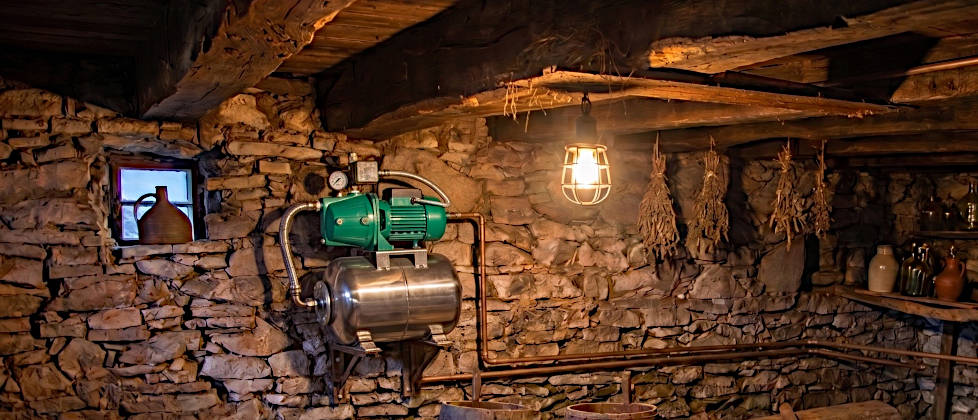
For me, the first question was the perfect location for the technology. I placed the domestic waterworks directly in the cellar. From there, a suction pipe leads outside to the well. In the cellar, the system is protected from frost, and the distance to the water source is relatively short, which makes the suction work much easier for the pump.
However, an important aspect in the old walls of my farm was the acoustics. A domestic waterworks turns on automatically as soon as the pressure drops (i.e., when I draw water outside or inside), and naturally, this creates vibrations. To prevent this structure-borne noise from transmitting through the walls into my living spaces, I mounted the system on a damping rubber mat and decoupled the pipe connections with flexible armored hoses.
Fine Water for Fine Work: The Right Filtration
Especially with older wells, the water often carries fine sand particles or other suspended matter. For the lawn sprinkler on the outside taps, this wasn’t a problem, but for my renovation work inside the house, I needed absolutely clean water.
Technical Details on Filtering Suspended Matter
To optimally use the well water for construction, I couldn’t avoid a solid pre-filtration. I installed a backwashable pre-filter (sand filter) with a mesh size of about 90 to 100 micrometers. This not only protects the impeller of my pump from mechanical wear but also ensures clear water. The quality of the filtration was essential for me: Only with absolutely sediment-free water could I mix demanding materials like the fine lime paint for the walls of my farm without risking discoloration or small granules in the paint.
Using Well Water for Toilet Flushing and the Outdoor Area
The bathroom offered the greatest savings potential for me in everyday life. My domestic waterworks now supplies the toilet flush and all outside taps on the property via a separate pipe network. Before I laid these pipes, however, I had to observe an iron rule: strict system separation according to DIN EN 1717.
Under no circumstances may there be a direct cross-connection between the public drinking water network and my private well water network. A simple shut-off valve is not enough here! I therefore color-coded all service water pipes in the house. This prevents me from accidentally confusing pipes during future remodeling work on the farm. I also registered the operation of the system regularly with the responsible authority.
How I Connected the Domestic Waterworks: Step-by-Step
So that you can understand how the installation went, I have summarized the most important steps of my commissioning here:
- Choosing the location in the cellar: I looked for a frost-free place and put the domestic waterworks on a vibration-damping base.
- Connection to the suction pipe: I connected the pump to the pipe leading to the well tube via a flexible, vacuum-proof suction hose and paid meticulous attention to absolute tightness.
- Installation of the pre-filters: To protect the pump and my water pipe network, I mounted the sand filter directly on the suction side.
- Pressure adjustment on the expansion tank: I adjusted the pre-charge pressure in the membrane tank to about 1.5 bar with a compressor. This way, the pump doesn’t start immediately with every small sip of water.
- Connection of the tapping points: Finally, I connected the pressure side of the pump to the newly laid, separate pipe network for my toilets and the outside taps.
My tip: If you are laying pipes outside anyway, install a frost-proof outside tap (Kemper valve) right away. This way, I always have water for work on the farm, even in winter, without having to shut off and empty pipes beforehand.