Hermannstadt, or Sibiu as it is called in Romanian, is undoubtedly a cultural center and a magnet for visitors from all over Europe. The gently renovated alleys, the large squares, and the lively hustle and bustle invite You to linger. But those who seek the true, original Transylvania must leave the beaten tourist paths. Only a relatively short drive away from the pulsating city, a place hides in a gentle hilly landscape where time seems to have stood still: the valley of Urwegen, often also mentioned in the context of Apold.
This travel report takes You to a place of silence. A place that tells of a volatile past and, for me as a photographer, represents an inexhaustible source of inspiration.
History: A Fortress Through the Ages
The history of Urwegen is deeply rooted in the settlement of Transylvania by German-speaking immigrants, the Transylvanian Saxons. As in so many villages in the region, life here over the centuries was characterized by hard agricultural work and the constant threat of external enemies. To protect themselves from Ottoman and Tatar raids, the villagers began to fortify their church in the Middle Ages.
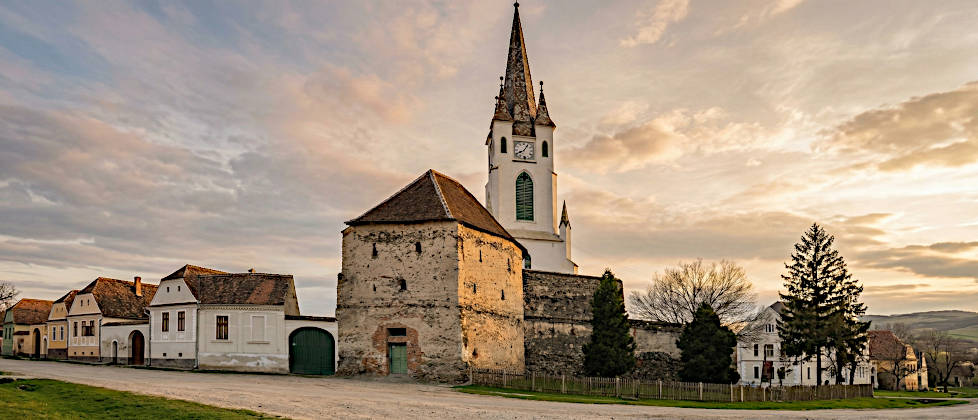
Urwegen holds an architectural and historical peculiarity: The complex is one of the last preserved Gräfenburgs (Count’s castles) in Transylvania. Originally built as the residence of the local nobles – the so-called Gräfen – it was only taken over and further expanded by the village community over time.
A fortified church was created. High ring walls, defense towers, and loopholes still bear witness to the unconditional will to defend the community. The church was not only the spiritual center but, in case of emergency, the last refuge for the entire village. For generations, the complex was maintained, expanded, and repaired until the massive geopolitical changes of the 20th century altered the face of the village forever.
The Current Situation of the Fortified Church: Silent Witnesses of the Past
With the mass exodus of the Transylvanian Saxons after the political changes of 1989/1990 in Romania, many villages were left almost deserted. In Urwegen, too, this turning point is clearly felt. The fortified church, once the pulsating center of a lively community, now stands mostly silent and imposing in the landscape.
The current situation is a mix of melancholic decay and hopeful preservation. While some parts of the ring wall cannot hide the traces of time and weather, there are always efforts by local initiatives, foundations, and former residents to secure the structure. The roof of the church was secured in the past to prevent water penetration. A walk through the courtyard of the fortress is like a journey into the past. You can literally feel the history in the old, hand-hewn stones and the massive oak wood of the battlements.
The Best Photo Spots In and Around Urwegen
As a photographer, I am always looking for motifs that speak their own language and convey emotions. Urwegen offers a fantastic backdrop for this. Here are my preferred photo spots:
- The portal of the fortified church: The massive wooden doors, often decorated with iron fittings, offer a wonderful frame for detailed shots. The texture of the weathered wood in contrast to the stone archways is a classic but always rewarding motif.
- The view from the hill: If You leave the village slightly towards the adjacent hills, a wonderful perspective opens up. Especially in the late afternoon light, the so-called golden hour, the sun bathes the valley and the striking roofs of the fortified church in a warm, soft light. The red tiles then stand out picturesquely from the lush green of the surroundings.
- The interior of the church: Provided You gain access (see tips below), the interior offers a very special atmosphere. The sparse light falling through the narrow windows draws hard shadows on the old wooden benches and the altar. A tripod is essential here to capture the quiet, almost mystical mood without distracting image noise.
- The alleys of the village: Even away from the fortress, an attentive look is worthwhile. The traditional Saxon farmhouses with their typical closed courtyards and colorful facades offer great architectural lines and an authentic picture of rural Romania.
Planning the Visit: Arrival and Key
Arrival from Hermannstadt (Sibiu): The drive with Your own vehicle or a rental car takes just over an hour, depending on the exact route and road conditions. Leave Sibiu in a westerly direction. The last few kilometers lead over easily navigable country roads that wind picturesquely through the hilly landscape. Use a navigation system so You don’t miss the exact turn-off into the valley.
The key to the fortified church: As with almost all remote fortified churches in Transylvania, the gate is not simply open. To visit the interior of the complex, You have to find the key keeper. Usually, there is a small note with a phone number (often in Romanian or German) hanging on the main gate. Alternatively, it is worth asking respectfully at the direct neighbors of the fortress, often in house number 1 or the parsonage opposite. The local people are usually very helpful. A small donation for the maintenance of the church following the visit is always highly appreciated and helps directly with the preservation of this cultural heritage.
Urwegen is not a place for fast tourism. It is a place for explorers, for people who can embrace the silence and seek beauty in the imperfect. Take Your time to explore the valley on foot, speak with the few people You meet, and let the special atmosphere of this hidden jewel work its magic on You.