Perhaps you know this moment: You are traveling in Romania and have discovered this one, perfect piece of land. Away from the hustle and bustle, surrounded by untouched nature and with a breathtaking view. The perfect place to build a house and enjoy life on site to the fullest. But looking at the papers, a term appears that initially brings many builders in Romania back to reality: Extravilan. What this status means, how you master the bureaucratic hurdles and convince the local Primăria (the town hall) of your project, you will learn in this article.
What does the status “Extravilan” mean?
In Romania, land is generally divided into two categories: Intravilan and Extravilan. Intravilan refers to the buildable area within the boundaries of a settlement. Here, building is generally unproblematic, provided local regulations are observed.
The Extravilan, on the other hand, is the so-called outer zone. It includes agricultural land, forests, pastures, and wasteland located outside the official settlement boundaries. The basic principle here is: Building is generally not permitted on Extravilan plots. It serves to protect agriculture and nature. There are only very few exceptions, for example for purely agricultural outbuildings, but for a private residential house, the legal situation is clearly restrictive at first.
The Path to Building Land: Conversion into the Intravilan
If your dream plot is in the Extravilan, this does not necessarily mean the end of your project. However, it means that you have to plan time, patience, and a certain budget for bureaucracy. To build a residential house there, the plot must be “pulled” into the Intravilan.
This is usually done via a PUZ (Planul Urbanistic Zonal), a zonal development plan. This plan is drawn up by an authorized architect and urban planner and must be approved by the local and often regional authorities. This process can easily take one to two years.
The First Step: The Certificat de Urbanism
Before you hire an architect or make deeper plans, you need to know exactly where you stand. The most important document in the early phase is the Certificat de Urbanism (CU), the urbanism certificate. It is not yet a building permit, but an informative document. It tells you exactly what status your land has, what building regulations apply and – most importantly – what steps and expert opinions (Avize) are necessary to be allowed to build.
You need these documents for the Certificat de Urbanism
To apply for the certificate at the Primăria, you must submit a file with the following documents:
- Standardized application (Cerere tip): You can get the form directly from the municipality or on their website.
- Proof of ownership: A current land register extract (Extras de Carte Funciară pentru informare), which should not be older than 30 days.
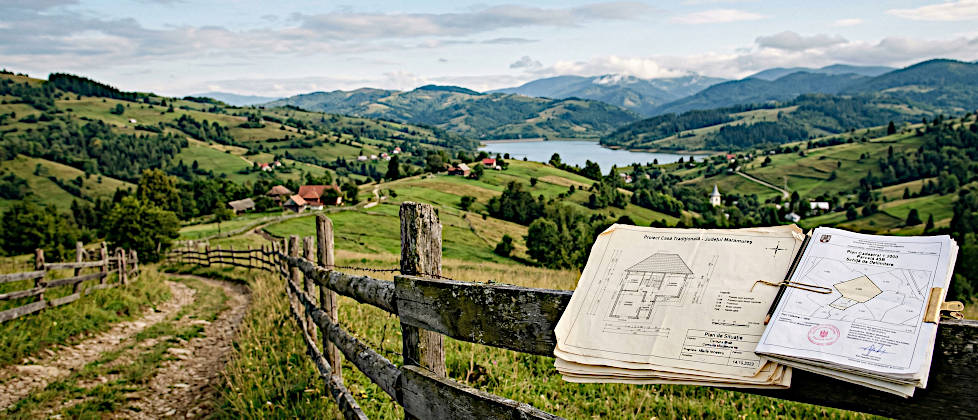
- Cadastral plans: Copies of the cadastral plans on a scale of 1:500 or 1:2000 as well as 1:10,000 (Plan de situație / Plan de încadrare în zonă), issued by the Office for Cadastre and Real Estate Registration (OCPI).
- Payment receipt: The receipt for the fee paid for the certificate (usually paid directly at the Primăria).
How to convince the Primăria
In Romania, many things are strictly regulated by law, but practical implementation often depends on the people on site. The Primăria is your most important point of contact. Here is some advice on how to win over the authority representatives for your project:
1. Seek personal contact: Do not rely solely on emails or official applications. Ask for an appointment with the chief architect (Arhitect șef) or the mayor (Primar), depending on the size of the municipality. If you explain that you want to settle in the region long-term, respect nature, and become part of the community, this often opens doors.
2. Show appreciation for the surroundings: Make it clear that your building project will not blight the landscape. If you plan to build a house that blends organically into nature and takes up traditional building methods of the region, communicate that. Authorities like it when local heritage is respected.
3. Work with local experts: Hire an architect and a topographer who are based in the region and maintain good relationships with the local Primăria. They know the specific requirements of the municipality and know how the files must be prepared to minimize questions and delays.
Further Information Sources
If you want to delve deeper into the matter or need official documents, these contact points will help you:
- ANCPI (National Agency for Cadastre and Real Estate Registration): On the official website of ANCPI you can find out about cadastral issues and sometimes request land register extracts online.
- OAR (Ordinul Arhitecților din România): The Romanian Chamber of Architects is a good place to find licensed architects for your PUZ.
The path from Extravilan to dream house is undoubtedly a bureaucratic challenge. But if you approach the matter well-informed, stay patient and ask the right questions at the Primăria, this hurdle can be overcome. The reward at the end is your very private retreat in the midst of nature.
My Personal Path: Why I Decided Differently
The idea of building a house in Romania came to me after I heard about the architect Ileana Mavrodin from Timișoara. She bought a plot of land in southwestern Romania and built an impressive cob house with the material extracted right there. Such an eco-house had always been on my mind – a project that would probably hardly have been feasible for me in Germany because of the high bureaucratic hurdles.
After spreading this vision in my Romanian network, I actually received an offer for a plot of land with a lake a few days later, not far from Ileana’s project. The fact that I ultimately didn’t do it is thanks to my friend Sergio Morariu. He brought me back down to earth in time: The house shouldn’t just be an occasional holiday home, but a place I can live in permanently. In hindsight, I am very glad for his advice.
I ultimately decided to buy an old farmhouse that is already in the Intravilan. The explanations made in this article about the Extravilan are therefore information that I gathered for myself back then and have repeatedly updated since – but they are not my own practical experiences.
Have you taken the plunge? If you can contribute your own experiences with building in the Extravilan, I look forward to your comment!