Imagine someone pressed the pause button thirty years ago and then left the room. That is exactly what arriving in Gherdeal (German: Gürteln) feels like. When you turn off the main road and approach the village via the dusty, unpaved track, you instantly leave the hustle and bustle of the 21st century behind you.
I first visited Gherdeal in September 2016. The month before, I had bought a house in neighbouring Cincu (Großschenk) and was busy getting to know the surroundings on the one hand, and looking for historical building materials to renovate my house on the other.
I keep coming back here; the place attracts me magically. Whether alone, with Elisabeth, or with my girlfriend Laura, a visit here always reveals something new and sharpens the eye for details.
Gherdeal is not an open-air museum where everything is polished and dressed up for tourists. It is raw. It is real. It is a place of melancholic beauty, breathing quietly in the heart of Transylvania.
In an old travel guide from my collection (“Komm mit…”) I read that you can breathe the purest air in all of Romania in Gherdeal. Today I can well imagine that – I didn’t experience the time before the Revolution, but there is indeed hardly any industry in the wider area.
Gherdeal today: A village in a deep slumber
Today, only a handful of people still live here. The statistics fluctuate; sometimes there are twelve, sometimes fewer. When you walk through the unpaved alleys, you hear mainly one thing: Nothing. Perhaps the buzzing of insects in the tall grass, the barking of a farm dog in the distance, or the creaking of an old gate in the wind.
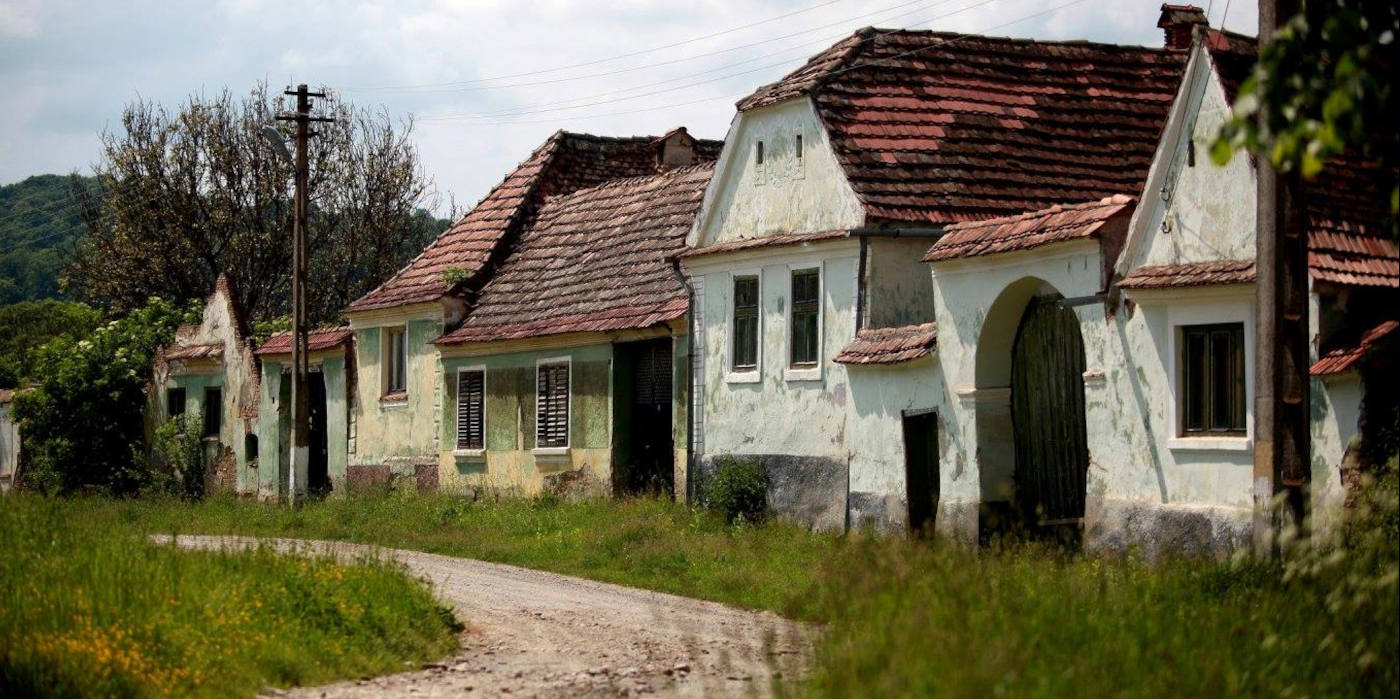
The rows of houses, once proud and colourful, now show the scars of time. The plaster is crumbling to reveal the brickwork, roofs have bowed under the weight of the years. But that is precisely where the charm lies for us visitors. It is architecture that forces you to walk slowly, look closely, and feel the stories hidden within the walls.
My request to you: Travel respectfully
Although Gherdeal is very quiet, it is not deserted. The few remaining inhabitants (often Roma families or a few returnees) are used to visitors, but common decency dictates that you do not enter private courtyards unasked. A friendly “Bună ziua” (Good day) often opens doors – and sometimes even the door to the church key.
A ray of hope: Casa la Tei
However, not everything is doomed to decay. There are tender signs of hope. A wonderful example is Casa la Tei. Here, an old property has been turned into a guesthouse with great patience and respect for the historical substance.
The house impressively shows what Gherdeal could look like if the heritage were preserved, even if new aspects have clearly been incorporated. Please note: Casa la Tei is a private project and retreat. If the gate is open, ask if you may enter. With a bit of luck, you can sweeten your break with a coffee or a lemonade and a bite to eat.
The silent witnesses: The Fortified Church and the Old School
Nothing shapes the silhouette of Gherdeal as much as the Fortified Church (Kirchenburg). It stands massive and defiant on its hill, even if the ravages of time are gnawing at it. Unlike in the tourist hotspots, there is often no ticket seller here. The fortified church is the anchor of the village – a symbol of the defensibility and faith of the former community.
Right next to it, often overlooked but deeply moving: The Old School. A place where generations of Saxon children learned to read and write. Today the rooms are empty, but the architecture still hints at the order and importance that education once had here. Work is done on it from time to time, but I cannot really discern a clear coherent plan.
A look back: How Gherdeal became what it was
To understand today’s silence, we have to turn up the volume of the past. Gherdeal was founded – like many villages in the Cincu Seat – in the 13th century by Transylvanian Saxons. The German name “Gürteln” first appears in documents around 1332.
For centuries, this was a flourishing farming village. People lived from agriculture, crafts, and the community. They lived self-sufficiently, maintained customs and language. It was a hard but orderly life.
The Great Exodus
The break did not come gradually; it came violently. After the Second World War and the years of deprivation under the communist dictatorship, most Saxons longed for freedom. With the Revolution of 1989 and the opening of the borders, the inevitable happened: The Great Exodus.
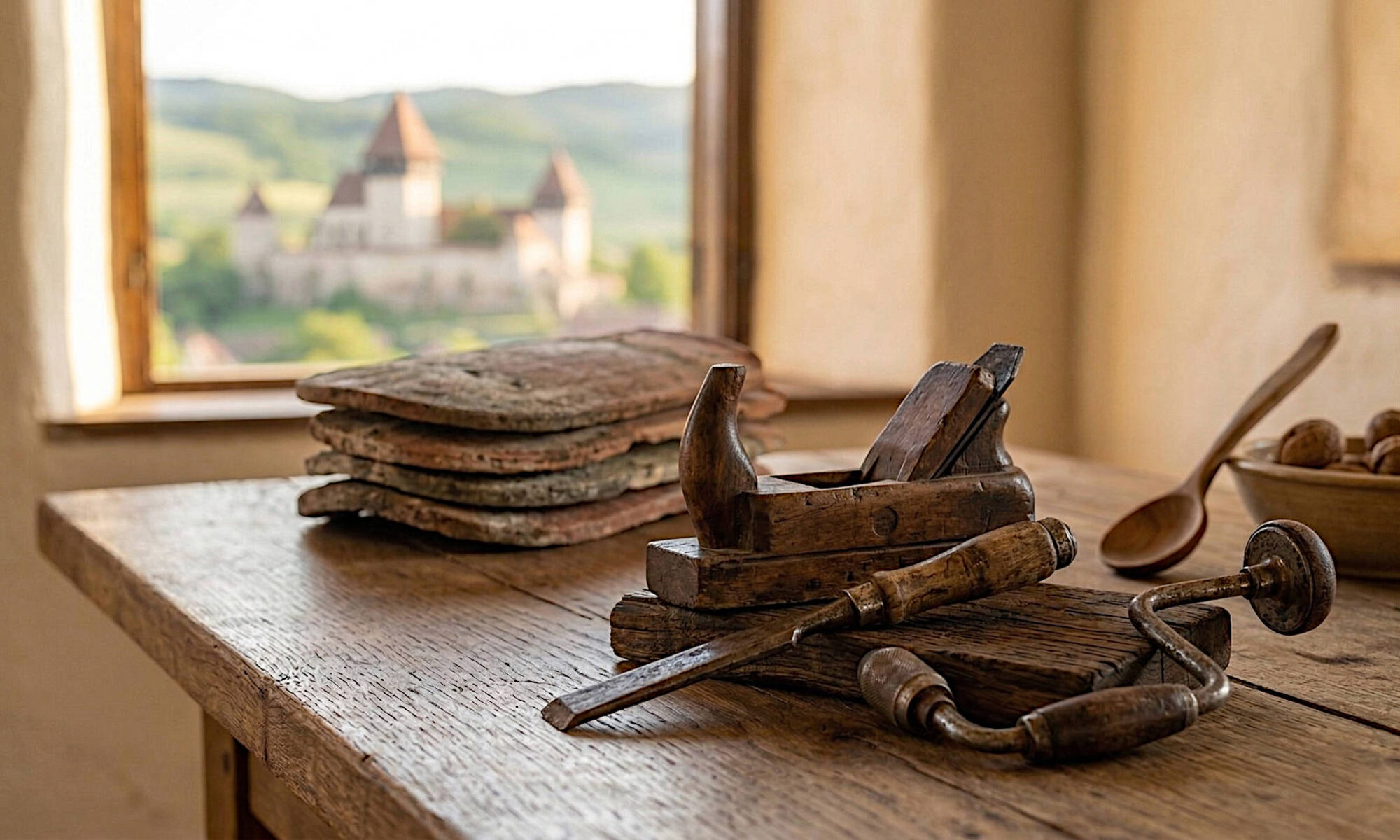
Within a few months and years, almost all Saxon inhabitants left Gherdeal for Germany. They left behind not only their homeland but often also their furniture, their tools, and their houses. Entire streets suddenly stood empty.
Who is Gherdeal the right destination for?
For Photographers
As a photographer, I can tell you: Gherdeal is a paradise for textures and lighting atmosphere. Definitely pack a wide-angle lens for the Fortified Church to capture its vastness. For details on the Old School or the house facades, I recommend a fast prime lens (35mm or 50mm).
- Golden Hour: The warm evening light often hits the facades of the main street spectacularly.
- Details: Look out for old inscriptions, rusted locks, and peeling layers of blue paint (“Transylvanian Blue”).
- Portraits: If you get into conversation with the locals, characterful portraits often arise (always ask first!).
For nature lovers and hikers
The surroundings of Gherdeal are picture-book Transylvania. Gentle hills, meadows full of wildflowers, and in the background – in clear weather – the majestic chain of the Făgăraș Mountains. A hike from Cincu (Großschenk) to Gherdeal (approx. 5-6 km) is absolutely recommended. You walk through a landscape that knows no fences, past flocks of sheep and through absolute silence.
Practical Tips & Accommodation
There is hardly any infrastructure in Gherdeal itself. There is no supermarket and no regular restaurant. That is part of the charm, but requires planning. Bring water and food.
Where to stay? The best base for a visit is neighbouring Cincu (Großschenk).
- Cincu: Here there are guesthouses and pensions, housed for example in the old Saxon parish house or in old farmhouses. Cincu is only a few minutes away by car and offers the ideal mix of authenticity and comfort.
- Agnita or Făgăraș: If you are looking for more urban infrastructure, these two towns are good starting points for day trips.
Gherdeal (Gürteln) – Compact
- Location: Sibiu County, not far from Cincu (Großschenk)
- Character: A Saxon village in a deep slumber (“Time Capsule”)
- Must-see: The historic Fortified Church and the Old School
- Special feature: Absolute silence and original architecture
- Access: Via gravel road (difficult when raining)
My tip for your visit
Take your time. Gherdeal is not a place to “tick off”. Sit on a bench, breathe the air, and let the atmosphere work on you. It is one of the few places in Europe where you can experience a genuine journey through time – fragile, beautiful, and unforgettable.