Today things are getting serious. It is August 19, 2016. A date that will change my life. At 09:00 AM, Laura and Urs arrive at our guesthouse in Brașov (Kronstadt). My motorbike group for this year has to do without their guide for half a day – but for a good reason: I am buying (my) a house.
Urs kindly offered to take over the tour with the group, for which I am hugely grateful. This allows me to concentrate fully on today. Laura and I get into the car and head for Făgăraș. Our car is packed to the roof with aid supplies that we want to drop off at the children’s home in Ghimbav this afternoon. I manoeuvre correspondingly carefully over the potholes and edges.
On the way to the notary: Tension rises
Hardly have we left Brașov when the road improves. The E68 is well upgraded, there is little traffic, and we make good progress. Laura is delighted that we will virtually be neighbours soon – her enthusiasm is contagious.
Arriving in Făgăraș, we are much too early. The satnav leads us slightly astray, but a passer-by points us the right way through a large gate. Since we still have time, we sit down in a café nearby. A few minutes later the sellers, Mrs. Wonner and Mr. Pantenburg, join us. It is a strange but friendly atmosphere – the farmstead is about to change owners.
The appointment: Notaries, interpreters, and hairstyles
Shortly before 11:00 AM we sit briefly in the waiting room of the office before being asked into the official room.
The situation has something solemn about it: Mrs. Wonner and I in front of the large desk, Laura and Mr. Pantenburg behind us – almost like witnesses at a wedding.
The state-sworn translator joins us. He claims not to have received my email with the draft contracts. But I am prepared and have everything printed out with me.
Then the waiting begins.
The academic quarter of an hour passes. Mrs. Wonner jokes that the notary lives right above. I briefly consider using the broomstick…
We use the time with the translator. He reads the German translation of the contract aloud while comparing it with the Romanian original. Everything fits, except for a missing unit of measurement (“sqm”) after a number. With stamp and signature, he certifies that I have understood everything.
Then the notary appears with jacket and handbag. An elderly lady, suitably styled, hair like fresh from the hairdresser – that explains the delay. She seems professional, speaks to me in German and switches to Romanian with Mrs. Wonner. Laura translates for me simultaneously, even though I understand a lot by now from the context.
Info: Buying a house in Romania
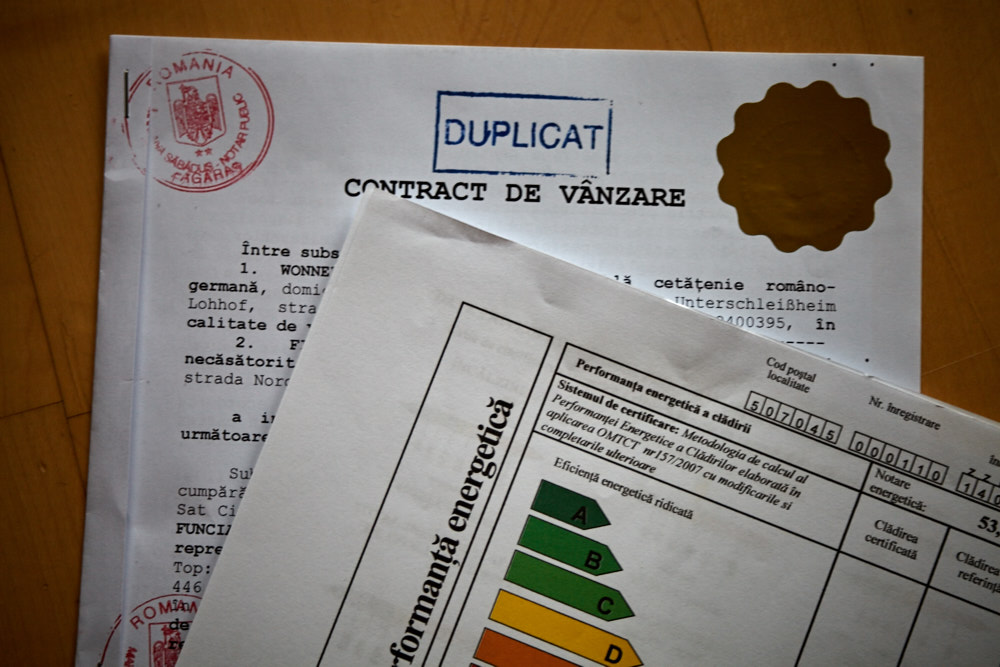
The bureaucratic effort is not to be underestimated. First personal details are established, then the extract from the land register is discussed. Then it comes to the purchase contract. A thick stack of paper comes from the anteroom. Copies were made of everything: ID cards, tax numbers, energy certificate, protocols. Every single page must be signed by all parties. The original is archived in the State Archives in Bucharest.
The moment of the signature
After the mountain of paper has been conquered, I pay the remaining amount of the purchase price in cash. Mrs. Wonner signs. I sign. The notary signs. From this moment on, I am officially the owner of a property in Cincu (Großschenk).
The notary shakes my hand and congratulates me. She says now it is time for me to learn Romanian properly if I want to live there.
The translator asks if he may issue his invoice because his presence is no longer required.
I ask what I owe. “5% of the purchase price,” he says dryly. I pause and start calculating. He laughs and says it was a joke. His fee is 50 Lei, which I hand him immediately, relieved in a double sense.
Race against time: Registration in Cincu
While the fees and taxes are being calculated in the anteroom and the purchase contracts are being finalized, the notary points out to me that I must register at the town hall of Cincu within 30 days. If I still have time, I should do it immediately.
It is already past 1:00 PM on a Friday. “Presumably no one is there anymore by the time we get there,” I submit for consideration.
What happens then is typical Romanian pragmatism: The notary unceremoniously calls the mayor of Cincu. She explains to him that “a German” is there who has bought a house. Thereupon she is assured that someone will stay there until I come.
I pay the fees, the tax, and receive a bon fiscal (the receipt – extremely important!) and three certified copies of the purchase contract. I am pointed out several times that I should keep them safe. The receipt is incredibly important to prove that I have paid.
With the papers in my pocket, we drive off.
Shortly after Cincșor we catch up with a slowly driving car with Bucharest plates. We quickly realize that it is Mrs. Wonner and Mr. Pantenburg. That is why we do not overtake. Laura enjoys the landscape and says I have chosen a beautiful corner.
Arrived in Cincu
Arrived in Cincu, Mrs. Wonner guides us to the town hall. We hurry to the first floor. The clerk is actually expecting us and asks me for the purchase contract, whereupon I take one of the three copies out of my folder. She checks the contract, stamps it, signs with date and time. Then she puts it in a tray and informs me that I am now registered as the owner.
That was it. I am registered.
Back outside, we say goodbye to the sellers and of course drive immediately to the house. Since we do not have a key yet (a neighbor who is still working has it), we only have a look through the cracks of the metal fence.
My house. My yard. My project.
Not much time remains for dreaming, because we have to go on to Ghimbav to the children’s home. For the afternoon we have arranged to meet my motorbike group at the children’s home, where we hand over our aid supplies and spend a little time with the children and especially with Maja, the head of the institution.
At dinner in Brașov we celebrate – even if I am not allowed to pay because I have “already spent enough money today”.
Buying a house in Romania – Facts & Tips
- Notary obligation: Real estate purchases in Romania must always be notarized.
- Translator: If you do not speak Romanian, an authorized interpreter is mandatory.
- Cash: Until 2023, cash payments were common (up to a certain limit), today much is done by bank transfer. Inform yourself about current laws!
- Bon Fiscal: Keep every receipt like a treasure.